
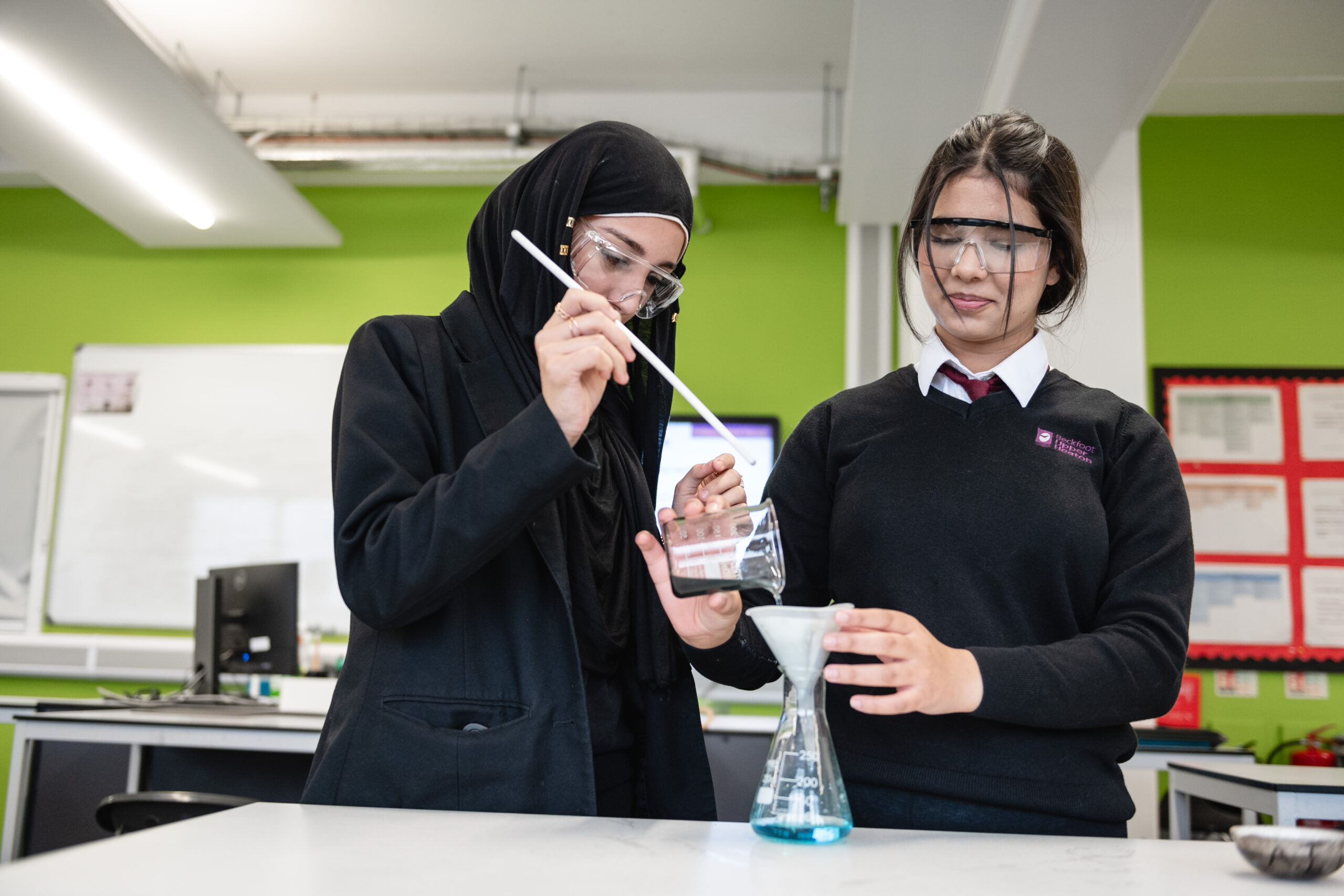
We want our students to critically analyse the world around them with a focus on protecting living and non-living resources and appreciating the value of major scientific breakthroughs in order to be able to articulate how they have contributed to the understanding of the world they live in, including and beyond their local context. We encourage students to foster their inquisitive nature to answer vital scientific questions throughout their time at school, and beyond.
Throughout the programmes of study, students will acquire the key knowledge identified within each strand of the National Curriculum, and ensure a systemic progression of key skills in accordance with the working scientifically expectations of the curriculum.
Students have the opportunity to visit places of scientific interest, as well as extra-curricular clubs to allow students further opportunities to work scientifically, understand the scientific
process and encourage students to ask questions beyond the scope of the National
Curriculum.
Summative and formative assessment will be used throughout KS3 to monitor pupil progress and further inform teaching and learning.
Science is all about moving forwards, developing improved technology and researching better ways of doing things. Students will develop skills which make them more employable and better able to cope with an ever-changing world.
| Year | Cycle 1 | Cycle 2 | Cycle 3 |
|---|---|---|---|
| Year 7 | Working scientifically: science and investigation skills Organisms: Movement and cells Matter: Particle model and separating mixtures | Forces: Speed and gravity Ecosystems: Interdependence and plant reproduction Reactions: Metals and non-metals and acids and alkalis | Energy: Energy costs and energy transfer Genes: Variation and human reproduction Earth: Earth structure and universe |
| Year 8 | Electromagnets: voltage, resistance and current Organisms: movement and cells Matter: Periodic table and elements | Forces: Contact forces and pressure Ecosystems: respiration and photosynthesis Reactions: Chemical energy and types of reaction Energy: Work and heating and cooling | Genes: Evolution and inheritance Electromagnets: electromagnets and magnetism Earth: climate and earth resources |
| Year 9 | B1: Cell biology CI: Atomic structure and the periodic table | P1: Energy | B2: Organisation C2: Bonding and the properties of matter |
| Year 10 | B3: Infection and response C4: Chemical changes P4: Atomic structure B4: Bioenergetics | C5: Energy changes P2: electricity C3: Quantitative chemistry B5: Homeostasis and response C6: Rates of reaction | P5: Forces B6: Inheritance, variation and evolution C7: Organic chemistry |
| Year 11 | P5: Forces B6: Inheritance, variation and evolutio C7: Organic chemistry | C8: Chemical analysis P6: Waves B7: Ecology C9: Chemistry of the atmosphere C10: Using resources | P7: Magnetism and electromagnetism |